Simple starter tasks can be the key to motivation and mastery in science
Why startup tasks?
Start-up tasks can help activate students' prior knowledge and provide a sense of mastery from the very first minute. Research shows that small initiatives at the beginning of class can have a major impact on both motivation and learning outcomes throughout the session. The transition from recess to learning activity can be smoother with the help of a short task prepared by the teacher in advance. Students who quickly find their place thus have something meaningful to work on, instead of falling into extracurricular activities or restlessness. When students come in, a picture or task can already be ready on their desks, be available on their digital tools or displayed on the board. If students are also encouraged to collaborate, space is created for community and a low threshold for participation. It is crucial that the task is open and engaging so that all students can participate and do the same task regardless of level.
Characteristics of good startup tasks
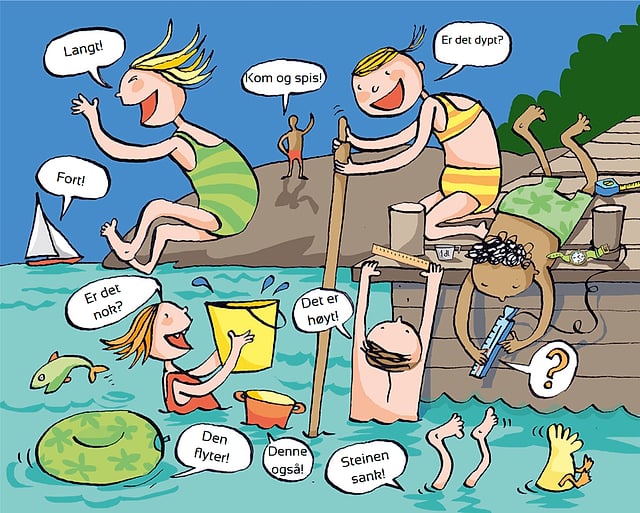
Good start-up tasks should be simple and short, ideally they should be able to be solved in 2-5 minutes. The tasks can be visual, for example a picture of a crowd on the board that arouses the students' attention and curiosity as they enter the room. They act as a bridge between recess and learning activity, and give the students a structured start to the lesson. It is an advantage if the tasks are related to the topic of the lesson, that they have a low threshold but high relevance.
Examples of startup tasks
In science, a task where students are asked to place pictures in the correct order can be a good start. The teacher prepares four pictures that show the steps in a process, and the students are asked to arrange them chronologically. An example could be a food chain: Who eats who? For the youngest students, the pictures can be on the desk, and the students can puzzle them out in order together with a learning partner. Alternatively, four students can each hold their own picture and line up in the correct order. For the oldest students, the pictures can be displayed on the board, and the students can write down their suggested order before discussing with a learning partner. In mathematics, the starting task can be as simple as: “Find two ways to make the number 12.” This task opens up solutions at many levels, it can be as simple as 6+6, but also more advanced such as √144=12. If the students first get a taste for such tasks, they can outdo each other in finding new ways to make a number. “Who is going out?” is an engaging starting task that can be used in several subjects. Four pictures, four numbers or four words are presented on the board. The students must then find out which element does not match the others and explain why. What makes the task particularly safe and motivating is that there is no single correct answer, as long as the students can explain and argue for their reasoning. Word clouds and concept maps can also be used in many subjects. The teacher writes a word or a number on the board, and the students are given 3–4 yellow pieces of paper at the beginning of the lesson. On the pieces of paper, they write down what they associate with the word or number. They then discuss in learning pairs, before choosing whether to contribute a piece of paper or two to a joint summary on the board.
Systematic work with concepts
The teacher can select one or more words that the class will work on in a concept map. Systematic work with words and concepts is particularly important for students with Norwegian as a second language, but Norwegian-speaking students also benefit greatly from exploring the language of the subjects in different ways (NAFO, ud). A concept map provides an overview and helps students see connections between words and academic topics. In the concept map, students can, for example, be given the task of explaining the word, creating an illustration, finding a synonym and using the word in a sentence. Word cards provide a practical introduction to concept work, the concept is on one side, the explanation on the other. The cards can either be ready-made by the teacher or developed together with the students. The digital teaching materials have a rich selection of concepts and explanations in different languages and can be used to produce such word cards and to work on understanding. The cards can also be used for games such as Memory, Guess the Word or Alias, where one student reads the explanation without saying the word, and the others guess. For students with Norwegian as a second language, digital learning materials with multiple language options can be a support in working with the academic concepts. They can also create a dictionary with Norwegian, their own mother tongue and an explanation. Students with Norwegian as a mother tongue can do the same, but translate into another foreign language, for example English.
Small steps with big impact
The most effective start-up tasks require little preparation, but can have a big impact. By giving the class a clear transition between recess and class, the measure can contribute to calmness and less disruptive behavior. The tasks should be easy to understand so that students can start immediately. Over time, they will expect classes to begin in this way – and look forward to it. The main goal is to make students ready and motivated to learn, while maintaining concentration and engagement throughout the class. When everyone experiences mastery right from the start, a culture of participation and security is created. Over time, this can contribute to positive attitudes towards the subjects. Small steps can therefore have a big impact.