Pronunciation from day one
I readily admit it. Pronunciation instruction was my guilty conscience in the classroom for a long time. Most other areas; vocabulary, grammar, writing practice, everything was neatly placed in the competency objectives and thus in my lesson plans, but phonics and pronunciation training always came far behind in the homework.
SHORT OR LONG A? Systematic work on pronunciation and listening training also affects students' spelling.
Many second-language learners are good at making themselves understood, even with pronunciation errors, and we therefore think that pronunciation “comes naturally” over time. But there are two reasons in particular to prioritize pronunciation instruction. One is the danger of fossilization. Language errors that are not corrected tend to remain with the second-language learner. Some may even start making new errors if pronunciation training is not maintained. The other is status. Yes, because it has been proven that we devalue second-language learners who have poor language and incorrect pronunciation. It is undeniable that having control over the language can provide both academic and social status. Therefore, it is important to include pronunciation training and phonics as a separate point in the teaching.
NorskPluss Phonics
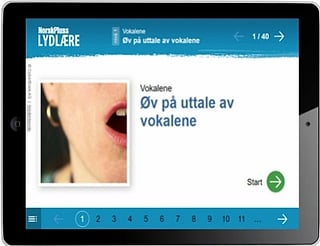
Here at Kunnskap.no we have created our own online resource with pronunciation and listening training, NorskPluss Lydlære . The course is suitable for both beginners and advanced learners. In my classes I have included a session with pronunciation training and phonics at the beginning of the lesson. It may be a good idea to divide the teaching into themes, such as long and short vowels, pronunciation of the sounds skj - sj and kj - ki, soft and hard consonants (plosives), vowels and diphthongs, and minimal word pairs. The program is an integrated part of the new NorskPluss Ungdom and VGS for Fagfornyelsen .
All of the second-language digital learning materials at Kunnskap.no are also equipped with an audio file where the text is read aloud. This way, students can practice both the word image and how the word sounds.
Other useful resources
The research community at NTNU has created its own pronunciation app, Norwegian Pronunciation , which can be downloaded for free. There, you can choose between 77 native languages as a starting point, so that the pronunciation training is adapted to the user's own native language. Students from, for example, Vietnam and Thailand have completely different challenges when it comes to pronunciation than students from Arabic-speaking countries. The Foreign Language Center has created an oral teaching booklet that is a toolbox for English and foreign language teachers, but which can be used with advantage by Norwegian as a second language teachers. Here are many good tips for exercises in listening, oral production and oral interaction.
________
The post is written by Helene Winsents. She has extensive experience as a teacher of Norwegian as a second language in upper secondary education. She is also co-author of NorskPluss Kort botid. Helene Winsents currently works at Nygård School in Bergen.