Numbers at a slow pace
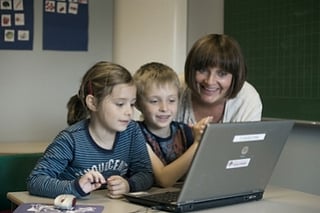
A school in Bergen is taking steps to prevent math difficulties at the elementary school level.
GETS A PRAISE FROM THE TEACHER: Teacher Siri Een is proud of how the students arrived at the answer. An animation gives them applause. Photo: Marit Hommedal
Siri Een is a teacher and works at Skranevatnet School. The school is a combined primary and secondary school and is located southwest of Bergen city centre. A year ago, the school logged in to the digital learning tool "I can count 1-4".
The online resource consists of several thousand pages. Each page unfolds similar tasks at a slow pace.
– The slow progression allows students to practice both concepts and terminology. They achieve a greater understanding of what is abstract, says Siri Een.
More to choose from
– I think the challenge is finding enough tasks at the right level. For example, I have students who are in third grade, but who follow the curriculum goals in second grade, says Een.
Together with colleague Trude Eide Haugen, the school joined as test pilots with the publisher CyberBook in the spring of 2014. The teaching tool quickly got screens glowing, and just over six months later, secondary school teachers also wanted to look at the possibilities.
Order a no-obligation 30-day trial
Tiered
Siri Een points to an interactive whiteboard. The whiteboard shows three cookies and the theme is "fraction notation". The students are to count pieces of cookies. The abstract is served with something edible. The task belongs to the "red" and demanding part of "I can count 1-4".
– In special education, we would like to include. When we work with the online resource, we can differentiate in both larger and smaller groups. The student gets to work with their classmates and they can work on the same subject, just at a different level, says Een.
– It is the presentation of the subject matter that is different.
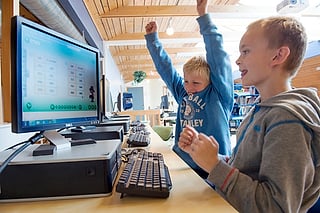
FULL POT: The boys from Skranevatnet School got everything right on the difficult module in "I can count 1-4". Photo: Marit Hommedal
Orange for special occasions
Siri Een herself has grades 1 to 4 in the normal school. The teaching material they use is structured by color. Orange for the youngest age group, yellow, blue and green, while red is considered the fourth grade.
"Orange" hides the numbers between 0 and 10, and "red" the numbers above 1000. Skranevatnet school uses the tangerine-colored part to a lesser extent. However, the two special schools Frydenhaug and Blindernveien (in Drammen and Oslo, respectively) have benefited from the module (both pilots together with Skranevatnet).
– The two special schools have received a lot for free with the orange module. I know they have spent a lot of time looking in books for good assignments, says Een.
Order a no-obligation 30-day trial
Reading aloud
Frydenhaug and Blindernveien have students who cannot read. This applies to several of them, including Siri. They need extra help with text assignments. "I can count 1-4" has built-in reading.
– Students can easily play a text assignment themselves. It is a useful feature for several of my students. We also play videos and listen together. Sometimes I play the films silently, that way they can test themselves, says Een.
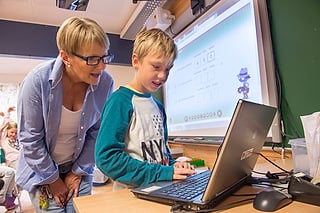
PRESENTATION: Teacher Bente Aadland at Skranevatnet School helps before the student presents in front of the rest of the class. Photo: Marit Hommedal
Seals holes
Although "I Can Count 1-4" is initially a resource for elementary school students, teachers from middle school have also requested input.
– They lacked tools to fill gaps. We see that teenagers can also benefit from working with the “red” part for fourth grade and still benefit from it, says Een.
"- I did it!"
Siri Een notices that the new math textbook has made her less dependent on the photocopier. Now the search has been turned upside down.
– Now instead, time is spent finding tasks in the online resource. There are an awful lot of them, but that's really a luxury problem, says Een and smiles.
The student evaluates himself via three different emojis that are eager to be seen (“I couldn’t do it”, “I needed some help!”, “I did it myself!”).
Sometimes they master tasks entirely on their own.
– “Look, Siri! I did it, I did it!”, they shout and pull me towards the screen. It's almost a bit comical when they understand something they just didn't understand, says Een.
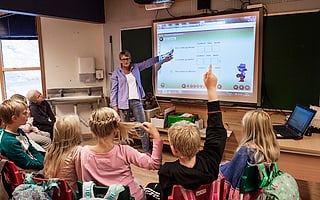
IV THE HONOR: Hands are quickly raised when Bente Aadland wants help with the calculations on the big screen. – What is correct here? Photo: Marit Hommedal