Give the student a sense of mastery through immediate feedback
Through practical and visual tasks that students solve directly in the learning material, they maintain better focus throughout the learning activity.
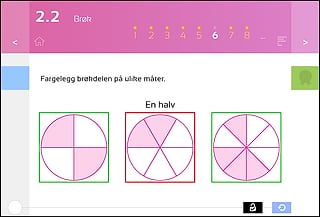
The student receives immediate feedback with green and red markings around the answers. The student can correct the answers themselves and experience mastery without having to wait for the teacher.
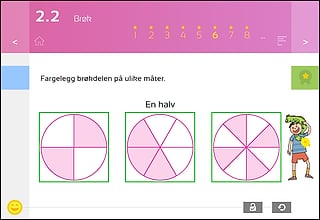
The teaching aids allow for different ways of thinking and answering. In the image below, the student chooses which parts of the circle to color in to get the correct fraction.
When all the tasks are solved correctly, the student receives motivating medals and animations that are both visual and auditory. All answers are saved.
Skip the time-consuming correction work!
All answers are saved and corrected automatically and provide a basis for the learning analysis. The learning analysis gives the teacher and student a very good basis for conversations that promote learning. Rather than spending time correcting assignments, the teacher can use the learning analysis for good guidance and learning conversations.
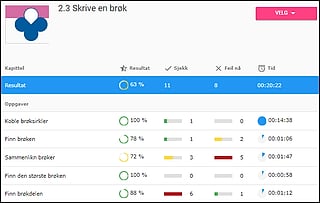
The learning analysis contains time-saving and learning-promoting information about the student's work.
The learning analysis shows that the student checks/checks his answers a lot.
Give students better feedback
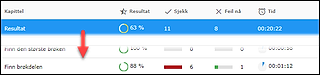
In the example above we see that the student has checked his answer six times. This may mean that the student is unsure even though the students otherwise make few mistakes. There can be many reasons why a student has a strong need to check, but the teacher can ask questions such as:
•Why doesn't the student trust himself?
•Are the tasks too difficult for the student?
•Does the student need extra guidance on the topic?
Give students better feedback
Give students customized assignments
The learning analysis is a good basis for giving differentiated tasks to students. In this way, students in the same class can both strive for more difficult tasks and work on easier tasks, without it becoming stigmatizing.
Get more time in the classroom.
The automatic correction means that the teacher spends less time correcting and has more time for learning-promoting guidance in the classroom.
•Learning analysis from Kunnskap.no – A tool for teachers who want to give their students learning-promoting assessments.
•If you need trial access or more information, you can contact Kunnskap.no at kunnskap@kunnskap.no or 22 95 80 80
We use cookies
Some are needed for signing in and the cart. Others remember your choices, such as light or dark theme. Read more about privacy
Customize cookies
EssentialSign-in, cart and security, including spam protection (Google reCAPTCHA) on registration and forms. Cannot be turned off.
Always on
PreferencesRemembers your theme (light/dark) on this device.