Feeling of mastery with a short stay
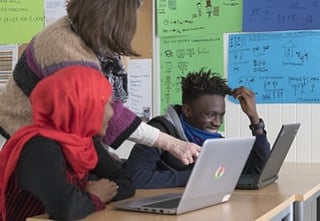
Despite major academic challenges, at Sjøvegan Upper Secondary School in Troms, students with a short residence experience mastery in Norwegian lessons. They allow themselves to be engaged. They speak up in lessons.
USING ALL THEIR LANGUAGE COMPETENCES: Engaged students in preparatory studies in conversation with teacher Hilde Andersen. Photo: Inger Kristin Hognestad.
Associate professor Hilde Andersen at Sjøvegan Upper Secondary School enjoys her job as a Norwegian teacher for students with short stays. After many years behind the chair, she is always learning something new.
Recently, a couple of Arabic-speaking students from Sudan gave a presentation to the class about their native language, Zaghawa, and compared the language with Norwegian.
- That's when I discovered the "camel alphabet" with writing characters based on the crests of different clans, Andersen says.
Multilingualism as a resource
Hilde Andersen is concerned that the students have linguistic and cultural competence that they can build on. Many of the students are fluent in languages. It is important to recognize this competence.
- I'm not concerned that Norwegian should be used all the time. Some students, for example, search for information in Arabic before writing a text in Norwegian. They have to use their entire language competence to understand, she explains.
At the same time, learning a new language is a long canvas to whitewash. Her students score low on reading assessment tests and have trouble understanding subject concepts.
No more cutting and pasting
Last fall, the school therefore started using NorskPluss Kort botid. The online learning tool has texts at level 3 with word explanations and interactive tasks.
"Now they remember what contrast, metaphor and simile are because it is explained in a simple and straightforward way. It is clear that the teaching material has been developed for them," says the experienced Norwegian teacher.
Before NorskPluss Short Stay, there was a lot of cutting and pasting from ordinary Norwegian books and textbooks in the subject "Norwegian as a second language", which disappeared with the Knowledge Promotion.
EASY TO USE: NorskPluss Short Stay takes special account of the students' linguistic and cultural background. Photo: Inger Kristin Hognestad.
Ahead of the rest of the class
Hilde Andersen has a group of Vg1 students preparing for college with five students from the same class. The students work with NorskPluss Kort botid when the other students have a foreign language. In addition, they participate in regular Norwegian lessons. Therefore, she collaborates closely with the other Norwegian teacher, and often uses her Norwegian plan as a starting point:
- I've tried to be a little ahead of the curve, so that the students get a little head start and are well prepared, she says.
She finds that the students understand a lot of the material, and hopes that the sense of mastery it gives in Norwegian can spill over into other subjects as well.
Self-propelled
NorskPluss Short Stay is used in almost all group lessons Andersen has with the students, either for independent work, joint problem solving and text review, or as a starting point for conversation.
"It's very clear and easy to use. Using the digital table of contents as a starting point, we can quickly find relevant topics and tasks," she says.
Andersen provides students with close follow-up and guidance when they work independently. It is an advantage that most of the assignments are self-correcting.
Necessary to follow the "short-term stay" plan
The school also has a group with a short stay in Vg1 vocational subjects, who also use NorskPluss Kort botid. They are offered two hours at the end of the day every Thursday. It is not considered voluntary, because as she says:
- This is what students need. Many people think they can do it when they are at level A2 in writing, but remember that they will be competing for jobs with people who are native Norwegian speakers or multilingual people with high competence.
And the students in Sjøvegan are being persuaded. It is important to give the students good information about the curricula, and what the choice of curriculum will mean for the academic outcome and the Norwegian grade.
Tips?
- Ask for a 30-day free trial with students, and attend courses run by Kunnskap.no . It was useful to hear about other teachers' experiences with Norwegian for linguistic minorities with short residence periods, she concludes.