Give me an Island
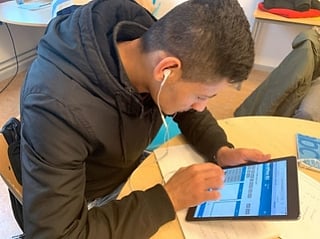
It was cold outside. Inside, several of the students were wearing winter jackets. They were working intensely. Youth from Syria, Afghanistan, and Eritrea were about to crack the literacy code.
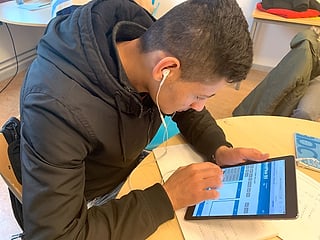
IN DEEP CONCENTRATION WITH NORSKPLUSS ALFA: Is "ø" first, in the middle or last? Kuben VGS has a separate offer for young people in basic reading and writing training.
Digital assistant teacher at Kuben
Kuben Upper Secondary School in Oslo offers Norwegian language training for young people aged 16 to 19 with a short stay in Norway. The course prepares students for admission to regular Vg1 classes or primary and secondary education for adults the following year.
"These are young people who will have to make up for several years of schooling in a short time and in a new language. They need all the help and support they can get. Here, digital has an advantage," says Anne Marie Eiby, who has worked as an alpha teacher at the school for several years.
In collaboration with Kunnskap.no she and fellow author Eli Tjørhom from Norskopplæringa in Sogndal have developed NorskPluss Alfa, a course in basic reading and writing with reading, listening and writing exercises for each letter. The main component is a comprehensive online resource for tablets and PCs.
Skøyen and Tøyen, but not eight
The letter "ø" is on the program in class when we are flies on the wall.
Anne Marie asks the students to name words with “øøøø”. She tries to make the letter sound. It mostly goes well, but sometimes they say words with “å” instead. It’s not so easy to hear the difference.
- Ears, yes! Onions, yes! Eight, no!
Anne Marie writes on the board. Everyone participates. They seem highly motivated. At the same time, the initiator clearly demonstrates some of the challenges the students face. When they don't hear the difference between vowels like "ø" and "å", it also becomes more difficult to write the words, according to the experienced alpha teacher.
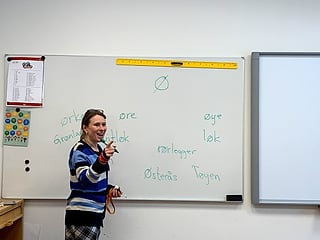
WARM-UP WITH "Ø": The students knew many words with "ø", and several of them were place names such as Tøyen, Skøyen and Grønland. Teacher Anne Marie Eiby did not have to drag the words out of them.
Copy allowed
Even in a relatively small group of students, students need a lot of individual support and help. That's why she has been using digital teaching aids and tools as a kind of extra teacher for several years.
After the starter, students are asked to copy words and sentences from a worksheet about "ø" into an STL+ program. These are words and sentences they will continue to work on for the rest of the lesson in various ways.
- In NorskPluss Alfa, we have planned for students to work a lot and in a variety of ways with the same words and sentences, in the online resource, in STL+ exercises and on worksheets, so that the skills will be automated, she says enthusiastically.
STL+ is a method where students type on a computer to learn to read. When they click on a letter on the keyboard, the letter sound is read, and finally the entire word when it is finished writing. The online resource also includes letter sounds in the keyboard.
Customized island training
Even after the STL+ block, not all students hear the difference between "ø" and "å". In that case, it is okay for them to have to work with the same words several times in different tasks in the online resource so that the word picture sticks more easily.
New words with "ø" are introduced in a digital picture word bank. Then work is done on recognizing the sound "ø", recognizing "ø" in words, combining sounds into words with "ø", writing sentences with "ø" etc. Anne Marie Eiby is close to the students. Answers and results are saved so that she can see whether the students have done the tasks, and how they have done them. Some have to do the tasks again. The students spend different amounts of time in the online resource. Some finish the chapter after 30 minutes. Others need 50.
The fastest ones work with worksheets from NorskPluss Alfa, while the rest of the students finish. First, they read some of the sentences from the chapter online. Afterwards, they get a sheet where the words from the sentences are put together in a pile. The task is to put them back together. In the picture below you can see one of the completed sheets (16 out of 16 points!).
« Ø » ON DATA AND PAPER: NorskPluss Alfa consists of a combination of online resources and worksheets. One of the curriculum goals is for students to have functional handwriting.
No downtime
There was no time for the dictation Anne Marie had planned at the end of the lesson. Instead, there was language play and fun based on the difference between "ø" and "å"...
Then "æ" stood for turn.