Free up time with NorskPluss B2
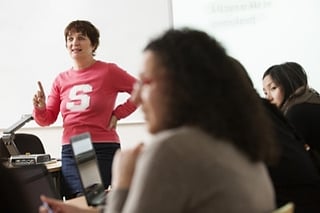
"We spend more time on oral presentations and less time reviewing homework than I have experienced in similar courses before," says Brazilian Stefanie Moran.
She will be taking the Norwegian language test B1/B2 at the end of May. Now is the final push.
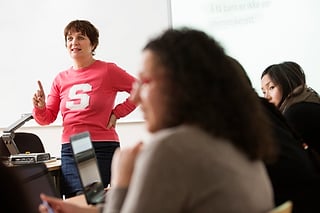
EFFECTIVE HOMEWORK: Participants in the "Digitalized B2 course" use their time at school for in-depth study and conversation. Teacher Marie Aalen ensures they are kept active. Photo: Sverre Christian Jarild.
This year, Oslo Adult Education Rosenhof has conducted a "Digitalized B2 course" with NorskPluss B2 as the teaching medium. All tasks and texts are collected in the online resource. Several people have signed up for the course precisely because the teaching medium is digital. Teaching takes place at the school three days a week.
In training
The activity level in the classroom is high. Some of the participants bring iPads from the department. Others bring their own machines. Most use a combination of computers and notebooks.
Teacher Marie Aalen is committed to ensuring that all participants are active. All the time. Almost as if they are in a group training session at a fitness center. She herself has written NorskPluss B2.
"What is it like to work with a digital Norwegian course?"
"It turns out that it makes more rational use of time. The interactive tasks stimulate homework and repetition," says Marie Aalen enthusiastically.
Oral argumentation
The class starts with "the news of the day," and an article that has already been published in the class's Facebook group.
Then it's time for oral practice for the Norwegian test. Each student will make a statement about a topic that was discussed the day before. After a few days of work with the "law and justice" module, the participants have mastered the challenging vocabulary.
"I think bail is unfair," says Stefanie. They have it in Brazil.
Some students defend the death penalty, others argue against it. The most important thing is that they practice expressing a point of view. A few short sentences in proper Norwegian. The other students listen attentively.
Flipped teaching
During the homework review, Marie asks if the participants have understood the grammar explanations above the interactive grammar exercises. Everyone follows along attentively on the interactive whiteboard as she flips from page to page in the online resource. Occasionally she stops:
"What is the grammar rule? Can you make up your own examples?"
The teacher does not need to spend time checking each individual answer to the question. The participants have already done that at home. They have also practiced each question several times where they needed to. At school they create their own examples with the new grammar they have had in homework. Along the way, she goes around and checks the sentences. It is important to use the rules in practice. They can also do the listening exercises at home.
Deep dive into school
The participants express that they like the working method. Not least, they appreciate that there is more time for conversation, because less time is spent on homework review. At least half an hour each day is set aside for group discussion.
"I like to do my homework on my phone, for example on the subway. At school we go into depth about things," says French Tania Sandler.
Classmate Rajkumar Rajangam appreciates the clickable word explanations in the texts. It means he spends less time figuring out what new words mean. And then he listens to the texts and repeats. He barely did that when he had the book with audio CD.