From PowerPoint to learning
To truly understand what the teacher is saying, it is not enough to just listen.
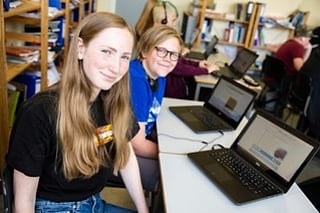
GOOD IN SCIENCE: The assignments in Syklus 8-10 have made Juli Erlimo Aasgaard and Tobias Stenberg Tallerud more curious about the subject. Photo: Lars Martin Bøe
In the past, a science lesson at Vardal School in Gjøvik often consisted of a science teacher who had prepared well. Jon Mikael Bjørklund had a template, key words and good illustrations. The students sat and followed along. Or did they?
– I still use PowerPoint, but not as much as before, says Bjørklund.
He has a long experience as a science teacher and with his professional commitment he is also exciting to listen to. And like most teachers, he waited for the students to break in and ask professional questions. But they didn't always do that. Many had dropped out.
Request a no-obligation 30-day trial!
Science enthusiasm
Bjørklund points out that science itself has a special position as a favorite among many students. Even though it belongs to the notorious science subject . The task is therefore to maintain this enthusiasm.
– They may have had a bad experience with mathematics in primary school. But we see that when they start secondary school, they still look forward to science. Many have had good experience with the subject before. Science is one of several gateways to later careers, says Bjørklund, referring to those who, for example, want to become engineers.
The school has for a long time used a digital online resource called Syklus 8-10 from Kunnskap.no . Precisely to build up the students' curiosity and enthusiasm for the subject.
– When we work digitally in this way, I see that something happens with the students. They have become more active and more engaged, says the science teacher.
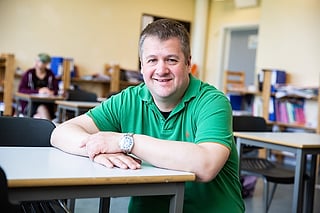
MORE ACTIVE: Science teacher Jon Mikael Bjørklund says that science is a subject that many people already have a positive relationship with when they leave primary school. He notices that students dare to participate more actively in class when they work with Syklus 8-10. Photo: Lars Martin Bøe
Learn on your own
Bjørklund has been concerned that students should have the opportunity to explore for themselves. It is not enough to just leaf through the textbook. Or to have seen the PowerPoint.
– Students will not understand what is in the textbook if it is unfamiliar to them. Then we must set aside a session to prepare the student for the new material first.
He says that the learning tool Syklus 8-10 has given the class a new gateway to learning about nature with multiple senses. Both sight and hearing are activated. The desire to learn increases. You tend to remember a good animation better.
– At the same time, I find that they don't disappear into the machine. They turn around and learn from each other. “What did you write there?” “Is 'blood' alive?” “Have you done that assignment?” They also learn a lot from the discussion itself.
Active in the profession
While teachers have moved away from PowerPoint, science classes have been moved to the computer room more often. Textbooks are being put aside more often.
– The great thing about science is that you can vary the teaching in an infinite number of ways. Syklus 8-10 contribute to the students becoming very active themselves. Here they get many explanations for each topic, they can play explanatory films and animations. It's different than if I were to tell them something they can't see, says Bjørklund.
The teacher points out that students in Syklus 8-10 are largely activated in their own learning, to a greater extent than in classroom-based and traditional teacher-based teaching.
– Science is a subject that is suitable for activating students, and the structure of the teaching material helps to activate them, he says.
Unknown substance no longer a barrier
Often the teacher posts a presentation on Itslearning, but the purpose is for repetition. To a greater extent, students now use the time to activate themselves through the digital science book.
This way of working should also take into account gaps in competence that should stem from the primary stage, regardless of whether the competence was initially high or low.
– The students become active in their own learning process. They are not afraid to delve into unknown or partially unknown material. What I have noticed is that the digital textbook actually also activates those who are at a lower level. You don't have to have all the concepts in place at first. The way Science 8-10 is structured, you can start where you are.
Competing against oneself
The teacher highlights the structure, visualization, animations and models as central to the learning material.
– It is important for many people in terms of learning outcomes. It must be easy to navigate the content and it is important to have varied levels of difficulty. Students can choose between tasks at many levels, which is how Syklus 8-10 work for those with high competence and those who do not have quite as high competence, says Bjørklund.
He says that some students are afraid of experiencing a poor sense of mastery and of competition with fellow students.
– But over time, many have discovered that they can compete against themselves. They see that it is important to prepare in the learning material, read the text carefully, listen actively, be active. There are many who are good at competing against themselves. They want to be as right as possible, and they get an overview of what they should work on more.
Discussing
– My role is more to discuss academic topics with the students. Bring out the wonder of the subject. For example, we can discuss what the leaf cells on a plant do, and a student raises his hand:
"They help the plants"
“How?” I ask.
"With cooking from sunlight," she says.
“Correct!” I say.
– Because she has seen it in movies.
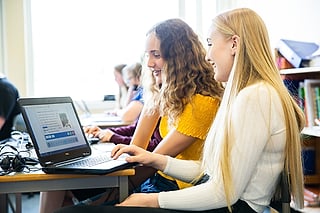
LEARNING FROM EACH OTHER: Sara Norstrøm Benbadi and Mina Christine Hubak at Vardal School often sit in pairs when they are working on the assignments in the digital learning tool. Photo: Lars Martin Bøe
Dare to participate in class
In the past, it was typically the brightest who raised their hands and signed up for class discussions.
– When we have discussions in class, I think more people dare to join in. At several levels. More people seem to have important concepts that make them dare to speak in the classroom afterwards.
Towards the end of each chapter, students are given a few minutes to summarize the lesson in writing.
“Do you remember the structure of a plant cell?” asks Bjørklund, pointing out that this helps students sort their thoughts in their heads.
– There is a nice free writing function within the learning tool. Here they also have access to a list of relevant terms: cell membrane, green grain, cell wall, etc. Their job is to integrate as many professional terms into the text as they can. When they are confident in the material, they are given the opportunity to read the text aloud.
– The threshold for discussing subject matter has become lower.
Everything is alive
Right now the class has been working a lot with animal and plant cells. They have learned that all living organisms are made up of cells. They can play a sequence of pictures showing zebras on grassy steppes, amphibians, amoebas and flowers.
They learn how the different cells determine the appearance and the different functions of organisms.
Once the students have familiarized themselves with the new subject matter through animations and explanations, they are given new tasks. In one task, for example, they must sort different keywords into their own columns.
“Water,” “blood,” “nylon,” and “stone.” What is alive?
– Then they must know what is made of cells and what is not made of cells, and that requires that they have followed the animation and explanation, among other things. The very structure and structure of the learning material triggers them to move on in the chapter, says Bjørklund.
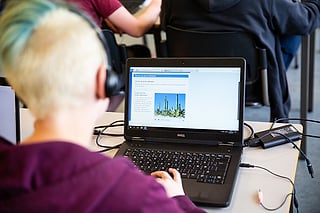
OVERVIEW: The students get to test their knowledge of the subject, and find it easy to navigate the structure. Photo: Lars Martin Bøe