From refugee to textbook author
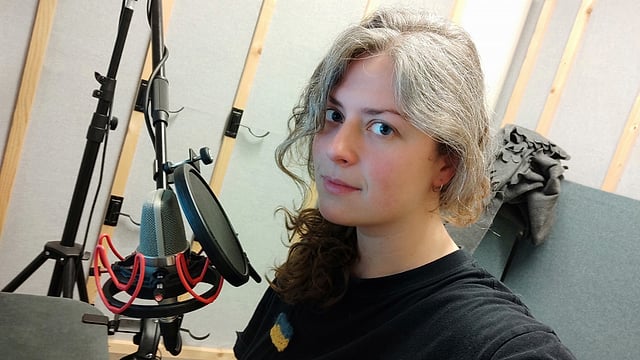
A Ukrainian refugee in Norway is central to the work of further developing a digital learning tool with the unique feature that Ukrainian students learn both mathematics and Norwegian at the same time. Forlaget Kunnskap.no has developed the solution and Olena Ivashkina is an important part of the development team.
On March 3, 2022, Kunnskap.no and other publishers are summoned to an emergency meeting with the Norwegian Directorate of Education. There, they are told about the need for translation and adaptation of existing teaching materials into Ukrainian and Russian. With solid experience from teaching materials for linguistic minorities, Kunnskap.no believed that it could contribute in a good way for the Ukrainian refugees. Trondheim Adult Education was contacted. They were able to tell about a recently arrived Ukrainian refugee, Olena Ivashkina. A Ukrainian author associated with Kunnskap.no , Irina Reitan, started the translation in March. She also points to Olena as a skilled mathematician and media developer.
From the media industry to real digital learning tools
In April, Olena Ivashkina came to Norway after experiencing the war up close for more than a month. Before the war, Olena worked for several years with film production, news, interviews, various educational projects and with tutoring students and adults in voice use. Olena has a master's degree in applied mathematics and has excellent language skills in English, Ukrainian and Russian.
From the refugee reception center in Trondheim, she is starting a large-scale translation project in collaboration with Kunnskap.no . A complete, fully digital textbook in mathematics for primary school, approximately 40,000 lines of text, was to be translated and recorded so that Ukrainian children could receive a good education.
Rewarding work
"I flew feeling that I have to save myself, but I found that I can also be helping people here"
The translation took time and Olena worked continuously for several months. From the refugee reception center in Trondheim, she translated, proofread, revised and improved. Olena felt she fled to Norway to save herself, but it turned out that the project would become a lifeline for her. She could help children and young people who flee to Norway.
“Direct translation doesn't work, I was using all my knowledge from university and school, and also recommendations from the ministry of education in Ukraine to adapt sentences”
Olena is precise and hardworking. She puts a lot of work into the sentence and task structure to make the translations natural. In this way, the students learn both mathematics and Norwegian. The students work with the same as their Norwegian classmates and receive both academic and social learning. The students participate in regular teaching from the very beginning. Bilingual teaching makes it possible to be independent of the teacher being able to communicate in the same language.
Taking back everyday life
“Being in the sound studio is very familiar to me, I finally felt I'm coming back to normal life”
Olena finds the translation process itself fun and rewarding. She enjoyed going through all the tasks. They have good illustrations and are creative. The structure is different than in Ukraine, but she believes the quality is good. Olena records tens of thousands of audio files in Ukrainian and Russian. In Ukraine, Olena spent a lot of time in a recording studio, including guiding actors in voiceover. She has a familiar and calm voice that provides a sense of security in life for young refugees. The time in the studio makes Olena feel that she was able to use the skills she has acquired in her career. In this way, she was able to take back parts of the life she left behind in Ukraine.
40,000 audio files are included in the learning material
In parallel with Olena and Irina, a team of developers in Oslo is working on inserting the translations and audio files into the learning tool. With 40,000 audio files and an equal number of texts, this is a task that requires great focus.
Developer Jan-Hugo Andersen led the work. He says that the start-up was hectic with training an extended development team. They learned quickly and the solution turned out well. Jan-Hugo is particularly pleased that switching languages is seamless and directly in the learning tool. This enables both Norwegian and Ukrainian young people to work with the same content. The students will master mathematics regardless of their language skills, and at the same time have support in the translations.
“The implementation requires crazy control, due to the amount of text and audio files, but also because 2/3 of the content is in a language we don't understand”
Olena and Irina have worked closely with the developers to make sure everything is correct. Working with someone who has experienced the war up close helped to give everyone at Kunnskap.no increased motivation in their work.
Science 5-7 and 8-10
Olena, and another of Kunnskap.no Ukrainian authors, Vitalii Oliinyk, continue their collaboration with Kunnskap.no . They are currently translating and recording the teaching materials for Syklus 5-7 and 8-10 into Ukrainian and Russian. Seamless switching between languages will also be central here, ensuring bilingual subject teaching in yet another subject. The teaching materials should be completed during the fall of 2022.