Subject refreshes well-known mathematics textbook
The popular learning tool I Can Count 1-4 has been sent through the curriculum turbine. A brand new version is coming out with a focus on faster progression and more interactivity. Here are the updates.
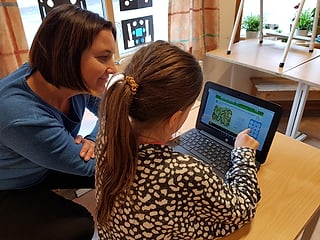
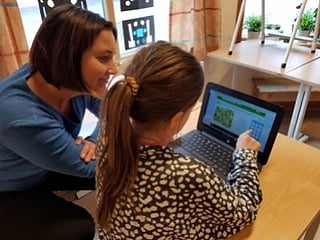
CHOOSE PLATFORM: Choose whether you want to work with I can count 1-4 on touch-sensitive screens, iPad or PC. – The teaching material adapts to all surfaces, and the tasks are fun, says teacher Siri Een (left).
Fun games, drag and drop and interactive videos that require students to reflect before they can continue playing. More focus on oral skills. These are just some of the things students can expect in the new edition of I Can Count .
Developer Jan-Hugo Andersen from Kunnskap.no summarizes this entire upgrade as follows: More emphasis on interactivity.
Andersen has a bachelor's degree in physics, has extensive experience in developing digital teaching materials, and has been involved in transferring the teaching material from 2013 to the subject renewal.
MORE THAN A FACELIFT: Developer Jan-Hugo Andersen talks about significant upgrades in I Can Count 1-4.
Mathematics where it happens
I Can Count is a teaching tool for grades 1-4. The teaching method is based on the fact that children at the beginning of their education have problems understanding abstract ideas. This is precisely why it is important to present the connection between real objects and mathematical concepts in everyday life.
– We have emphasized that the student should be able to explore while at the same time making the learning material fun to work with, says Andersen.
For example, the exercises now use drag and drop extensively. This makes it fun, but also more interactive, to work through the exercises.
Furthermore, the first edition of I Can Count had a lot of exercises in each chapter. These have now been pared down, leaving fewer exercises and room for faster progression.
“The tasks have become much more concrete,” says Andersen.
Think for yourself
In line with the subject renewal, there will be interactive videos that encourage students to think through mathematical questions. The tasks have become more exploratory . Students must ask themselves more questions along the way.
– We have included thinking breaks in the videos. The videos stop automatically and the student must physically click to continue. They are encouraged to reason and think along the way, explains Andersen.
Analyzing a problem
A pilot school that has been involved in the development of I Can Count 1-4 is Skranevatnet School in Bergen. It has been central to the school that students should have the opportunity to analyze.
– The students must think of possible solutions on their own. Throughout the course there is a great variety in intuitive activities. The emphasis is on little text and lots of audio instructions, says Siri Een, teacher at Skranevatnet School.
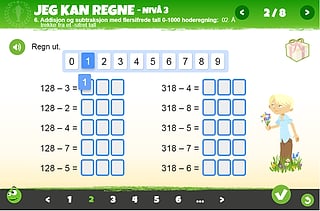
MORE INTUITIVE: The task shows an example of using "drag and drop". Students must move the correct number into the correct box. Screenshot: I can count 1-4 .
Oral skills
The pilot school has focused on the basic skills in vocational renewal.
– It has been important to create tasks where students can work on oral skills, something we thought was lacking in the previous version, says Een.
Through conversational images and videos with intriguing questions, I Can Count encourages students to talk about mathematics, form opinions, ask questions and argue for their choices.
– We have also emphasized conceptual training in these videos, Een further explains.
It has been essential for the pilot school that the tasks appear inspiring to the students.
– Mathematics should be exciting! Linking the tasks as closely as possible to everyday and practical situations has therefore been essential.
Tested on students
The two teachers Siri Een and Trude Haugen Eide have aimed to test out I Can Do Math on the students at Skranevatnet School.
“We have gone through the entire teaching material to see which tasks needed to be updated to meet the requirements of the new mathematics curriculum. We have also worked on creating scripts for exploratory questions in the animated films,” says Een.
Emphasis has been placed on ensuring that the tasks are exploratory in nature and that students are active in their own learning process by finding different solutions to a problem.
More learning-friendly
– As Jan-Hugo mentioned, we have tried to think about quality and not quantity when it comes to the tasks that will be included in the teaching material. There are still a lot of tasks for each subject, but we have peeled away the tasks that we experienced as not very motivating and not very conducive to learning for the students, explains Een.
She further explains that even children who have not cracked the reading code will be able to work with I Can Count .
–We have worked to ensure that all task instructions have audio support, especially in I Can Count 1a and 1b , as well as I Can Count 2 .
Students in grades 1 - 4
The tasks are designed so that students first wonder, and then work on concrete tasks before eventually moving on to more abstract tasks. There are still many tasks for each subject and the degree of difficulty and level of abstraction varies within each subject.
– Who would you first and foremost recommend I can count on?
– We believe it is possible to adapt I Can Count to most students in grades 1-4. In combination with different working methods and practical work, we also think that I Can Count opens up the possibility of working with the teaching material by theme.