A good start in Norway
- Just today, a couple of students were sitting there laughing and saying: Look here! to show me how funny this is.
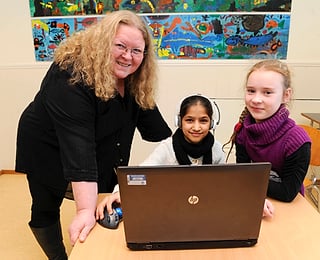
Both teachers and students at Andebu School enjoy NorskPluss Barn. From left: Bente Sparby, Miriam Tajik and Vijune Vaicikauskaite. Photo: Atle Møller
For Bente Sparby, a teacher at Andebu School, it is important that teaching is enjoyable, not least for newly arrived students who are starting Norwegian lessons for the first time.
"When a program manages to get the kids emotionally engaged, we know that it enhances the learning effect. The games and entertainment component in NorskPluss Barn motivates," says Sparby.
Everything in one place
She refers to a third-grade student from Lithuania who uses NorskPluss Barn. According to the student, it is the combination of images and sound that captivates her. Before the student came to Norway in August, she did not know a word of Norwegian.
- Before, I used several different teaching aids and digital tools to do the same thing that NorskPluss Barn does. NorskPluss Barn brings together images, reading, writing and sound in one place. The language is put in context and the teaching aid has a gradual progression. It gives room for many different ways to practice, says Bente Sparby enthusiastically.
From the screen to the concrete
1 in 10 students at Andebu School have Norwegian as a second language. Students with basic and special Norwegian work in small groups for up to 7 hours a week, in addition to being integrated into regular classes. The school uses NorskPluss Barn in the Norwegian language teaching of newly arrived students.
Often Students work independently with the online resource.
- How do you collect the threads?
- NorskPluss Barn consists of many live animations. We can transfer what we see on the screen to concrete situations in the classroom. After the students have worked independently with the interactive tasks, we have role-plays and other oral tasks in the groups. My experience is that the students communicate much better when they have practiced the concepts beforehand, says the enthusiastic teacher.
Starter pack regardless of reading ability
For Bente Sparby, it is essential that students can work independently with the online resource. To be successful, she spends plenty of time instructing her students.
- I spend a lot of time instructing the students, and following up to ensure that they are working as I have instructed. They receive clear guidelines on how to work with the online resource. They learn, among other things, strategies for what to do if they do not understand words. In that case, they should use "Lexin", "Google translate", search for the word in "Google images" or get help from adults at home, if it is homework. If they cannot figure out the word, or are unsure, they write the word down in a book and ask the teacher later.
- What about the illiterate?
- Illiterate children are first put to work with " NorskPluss Barn – Bildeordbank", which contains many similar tasks. They also do not require reading skills. Here the children learn to understand and pronounce words that are familiar to children who have grown up in Norway.
She believes this is something newly arrived students should work on regardless of whether they are illiterate or not.
- It's a good starter pack. You need to have a basic vocabulary to be able to communicate sensibly.
The responsibility of all teachers
Sparby emphasizes that students who use NorskPluss Barn must receive follow-up when the students are in regular classes. All teachers at the school have been introduced to the tool.
- This is how teachers can help when students are working with the online resource at school. Most of the time, the students are in regular classes. For us, it is important that the students get good help where they are, concludes Bente Sparby.