That's why they look forward to their homework.
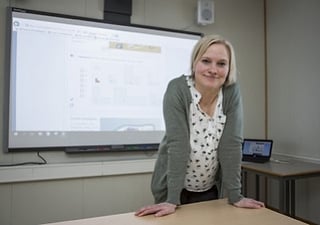
BOARDMAT ON SMARTBOARD: They like to work in small groups and talk together to arrive at the correct answer. For Randi Aaseth, the new teaching tool has been an important resource for mathematics teaching. Photo: Arnfinn Johnsen
Two years ago, teacher Randi Aaseth at Vardal Junior High School in Gjøvik joined as one of several pilots in a new mathematics project together with the publisher CyberBook:
How to help students who need extra support in mathematics at secondary school?
The result has been the new teaching tool BrettMatte for the middle school level.
Digital for the youth level
– The project itself was very useful for us, as we had the opportunity to familiarize ourselves with something, in addition to the textbooks themselves. The result has been a new teaching tool that we have put to good use in our school, and which I see has been useful for our students, says Randi Aaseth.
For her and the other teachers in the pilot project (teachers from Røyken Junior High School and Skranevatnet School have also been part of the pilot group), it has been particularly important to work with concepts .
– Many people struggle to understand concepts, and then they stop. It is important that students know what is being asked. Some struggle with using algorithms. Take division, for example. Where is the best place to start? This is what will be made easier with BrettMatte, says Aaseth.
GROUP TEACHING: Students at Vardal Junior High School like to sit in groups when they are working with the learning material. Photo: Arnfinn Johnsen
Smaller text
According to the teacher, it has been important to minimize the amount of text, in addition to spending a lot of time explaining difficult concepts.
– Many people struggle with complex word problems. We see this especially where multiple calculation operations are required in the same problem.
Less text and more animations run like a common thread through the new teaching tool that teachers have helped develop.
– What has been their role in the project?
– Right from the start, we have been involved in reviewing the material. We have picked up what we want to include further, and removed what we have not seen as pedagogically useful. We have emphasized many explanatory animations, and in some places we have put in place several tasks within one and the same topic, explains Aaseth.
Curriculum from kindergarten and grades 8-10
Students who need extra support in mathematics have been central to the development of the teaching material. The emphasis has been on slow progression.
– We have taken the curriculum from grades 1-4 and the curriculum from the middle school level. This mix has given us a teaching tool with an emphasis on slow progression. BrettMatte has become a teaching tool intended for students who have had challenges in mathematics, says Aaseth.
A lot of subject matter from the primary school level gives students the opportunity to review.
– For some, for example, the multiplication tables are not in place when they reach the junior high school level. If they don't know the basics, it's easy to stop later, says Aaseth.
In a group or with the whole class
At Vardal Junior High School, the teaching tool is used in small groups or with the whole class. Eventually, BrettMatte will also cover the curriculum up to grade 10, and not up to grade 8 as is the case today .
– When I was in 8th grade, I really benefited from Brettmatte as an extra addition to my teaching. We have used the smart board and have had many good discussions about text assignments together. It has also been useful in a slightly smaller group I have worked with.
She also has good experience giving out tasks from Brettmatte as homework to some of her students.
Homework gave self-confidence
Randi Aaseth was pleasantly surprised when a student started to push for more homework. The student had challenges in math, but gradually felt a growing sense of mastery.
– She actually ended up spending a lot of hours with the learning tool. She was in a hurry and wanted me to post more tasks as homework. What was crucial for her was that she understood a lot of the little animations. She could control a lot herself and had the opportunity to check along the way, says Aaseth.
– So she ended up spending more time on math than she would have otherwise as a result of this online resource. I thought that was fun.
Small chapters as homework
The learning material has a slow progression and is divided into small chapters. Since all topics are not collected in one chapter, it is also easier to give out as homework.
– There is always a variation in the type of task. I see that the tasks are engaging. The animations are short, preferably no more than a minute and a half. Since they are so short, it is easier for those students who have extra challenges in mathematics, concludes Aaseth.
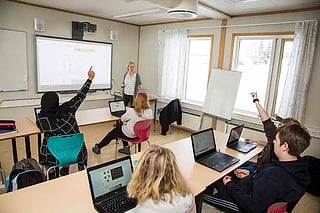
ENGAGEMENT: Slow progression leads to a larger proportion of students understanding and being able to engage in math class. Photo: Arnfinn Johnsen