Teaching track 3
By Marie Aalen
It may be easier to teach people with higher education than with lower education. But in some ways it can be more challenging.
Last week I gave a course at the planning days for the adult education centers in Oppland where I addressed the following questions: What are track 3 classes? How and how fast do they learn? How can we teach them? The article is a summary of the course.
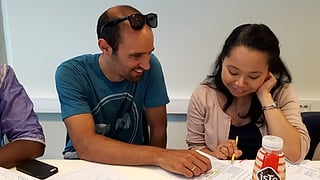
ORAL TRAINING: Students on Track 3 often learn to understand quickly, but often have problems expressing themselves. Targeted teaching is needed for them to improve. Photo: Eli Tjørhom.
Who is the typical Track 3 student?
Perhaps 20 years ago, students were divided into so-called near- and far-language students. The near-language students were those who often had English, German, Dutch as their mother tongue. Later, the division was renamed to track , and today the Track 3 classes are primarily defined by the students having higher education, and that they have a good command of a Western European language, preferably English. The class consists of people from all over the world, who have often come to Norway for family reunification with a Norwegian or as the spouse of a person who has obtained a good position in Norway. In addition, the goal is usually to pass B2 in order to be able to continue with higher education in Norway or to have the opportunity to practice certain professions.
How does a Track 3 student learn?
There can be many advantages to teaching a track 3 class. They have learned to learn and often have a great capacity to learn quickly. They are used to taking notes. They often have knowledge of grammatical concepts and remember to a large extent what they learn from rules, which means that they score high on diagnostic tests. They have experience in learning other languages and can transfer knowledge from what they have learned before. But in addition, the track 3 participant has a number of expectations. A track 3 student wants to understand all the words and vocabulary, to test out what she can both understand and produce orally and in writing, to get feedback on pronunciation and grammar and, not least, to use her time effectively, not to wait too long, to be active and goal-oriented throughout the lesson.
How to teach Track 3 students?
We should prepare to explain details, even before students ask.
The desire to understand "everything" in the text means that we teachers must be prepared to explain a lot of grammar, including things that are not in grammar books or are focused on in the textbook. When we get questions that we cannot answer there and then, we should always try to find the answer for the next lesson. We should therefore acquire in-depth knowledge of n2 grammar and preferably of contrastive grammar.
Use of English in teaching.
I teach in Norwegian, step by step through exercises, and explain everything in Norwegian. In this sense, I do not use English in teaching. But when it comes to individual words, I can translate into other languages . Then it is an advantage that all the students know English. I also ask students to help each other understand words: What is it called in Arabic? This way, the participants become learning resources for each other. Comparing their mother tongue and other languages with Norwegian activates previous knowledge the participants have, which gives a feeling that they can contribute something, not just receive.
Don't forget oral training
We may find that some of these students have better reading and grammar comprehension than the ability to speak correctly and fluently. This means that even if they understand quickly, we must not forget that they also need a lot of oral training in the classroom so that the ability to express themselves keeps pace with the ability to understand. My starting point is that everything in a text should be learned as actively as possible, before we move on. The text should not just be understood. Therefore, time at school is largely spent on oral and written training as well as conversations about vocabulary and grammar.
Read more about the working method in the article: "More conversation and immersion with digitalized Norwegian courses" .
Language acquisition is not about learning about a language, but about the language becoming a part of you.
A new language has different semantic categories and grammatical structures than those that have been practiced through the mother tongue. It therefore requires a lot of practice to speak and write a new language correctly and fluently. This also applies to track 3 students. You have to practice to get better. That is why we must have a separate methodology that includes a lot of work with automation in addition to free exercises . This automation includes, among other things, structure exercises, but also other exercises. In the Teacher's Guides for NorskPluss B1 and NorskPluss B2, I give many specific tips for varied exercises. In addition to set exercises, we should always let students create their own examples with words and structures. Only then can we know whether the word and structure are actually understood.
We should have "metalinguistic" conversations in class, where we talk about the differences between languages.
This topic has been given its own module in NorskPluss B1, Linguistic Diversity, which in 9A deals with some differences between Norwegian dialects, and in 9B deals with differences and similarities between languages and language families. Seen from a world perspective, there is much in Norwegian that stands out, and therefore can also be difficult for Track 3 students. A well-known issue is word order in Norwegian. But have you thought about the fact that many languages lack such a common word as "heter"? They have other ways of expressing this. (In Norwegian we have three). Instead of jeg heter they say "mitt navn er..", "jeg kalles.." Maybe that is the reason why many students use "betyr" instead of "heter", in the sentence Hva betyr det på norsk?*
What is "strange" in the text?
One way we can check if there is something strange about the Norwegian language from the students' perspective is to translate it verbatim for ourselves, from Norwegian to English, to see if it makes sense. Take, for example, Jeg har båld tid. = I have bad time. It is clear that the expressions god og båld tid , and e.g. god og båld råd (= bad advice?) can easily be misunderstood, and in every text there will be a number of things that we cannot take for granted that the students understand. When the students start a letter with " Hvordan er du? Jeg er bra", this is a direct translation from English, a misunderstanding that should be quickly cleared up. In order to clear up this and other types of errors, it is important that all students receive feedback from the teacher every day. Track-3 students, who are often independent and disciplined, have a great capacity to learn from their own mistakes when they become aware of them
Conversations in pairs or groups are good practice, because you have to recall words you have learned.
Frequent use of the language is important. Group discussions are both important socially and for exchanging and developing opinions. The problem is that we as teachers cannot hear everything the students say in the groups. One student wrote: “In my Norwegian course, I try to make conversation with my classmates. But it is just a good practice to use new verbs but no one is sure if we are correct or not.”
After the group discussions, it can therefore be useful to let each student say a few sentences out loud for feedback. We should strive for a safe and pleasant atmosphere where everyone is active and wants to try using the language: Teacher, can I say...?
Flow without correction easily becomes "flow error".
Fluency is important to keep the conversation going, without the conversation partner switching to English, which is something many Track 3 students who want to speak Norwegian experience. Most Norwegians are not good at correcting the language of their utterances. A lot of time must therefore be allocated to oral training in the classroom. Fluency can also be achieved by listening and repeating. Memorizing sentences and repeating them until they say them correctly is also an effective method that we can recommend to Track 3 students so that they can reach their potential.
How long do Track 3 students spend?
Track 3 students can complete A1-B2 in 1 ½ years, and if the law and compulsory students, who have 600 hours for free, are to complete B2 without having to pay, this should be the goal.
Western Europeans have the advantage of being used to writing argumentative texts and are familiar with many of the social issues discussed at the B2 level. However, it turns out that many need a whole year to get from B1 to B2, especially those who do not have a Western background. Some participants who progress quickly from A1-A2, often helped by speaking Norwegian at home, eventually have more difficulties. These students have often studied in English, but they are not completely fluent. Their mother tongue is only used in everyday life. They are not 100% confident in any language. This can make them more uncertain when it comes to learning concepts in a new language at a high level. The intro students, who also sometimes attend Track 3 classes, often struggle with pressure about income and residence, and a number of other problems that take attention away from school – plus they spend time learning argumentation and getting to know “Norwegian values”. That is why they often need 2 years.
As fast as possible, but as slow as necessary.
The most important principle of teaching is: We go as fast as possible, but as slowly as necessary. It is more important to learn things so that they stick, than to move on quickly. But the satisfying thing about the Track 3 class is that if we focus on something, it doesn't take that long for it to stick.
Marie Aalen is the editor of the NorskPluss series and has been a teacher at Oslo Voksenopplæring Rosenhof for 30 years. Marie has extensive experience in teaching and using digital language courses. She has developed assessment tests in Norwegian for the Oslo VO Servicesenteret. Marie Aalen has a Nordic major and Norwegian as a second language in her professional circle.